The Camino de Santiago has dozens of routes, but seven carry almost all pilgrims: the French Way, the Portuguese Way (Central and Coastal), the Northern Way, the Primitive Way, the English Way and the Vía de la Plata. The French Way is the classic and the busiest, the Portuguese Way is the gentlest two-week option, and the Primitive and Northern Ways suit fit hikers who want quieter trails.
Below you will find a side-by-side comparison, a short profile of each route and a simple way to choose based on your time, fitness and the kind of trip you want.
All main Camino routes at a glance
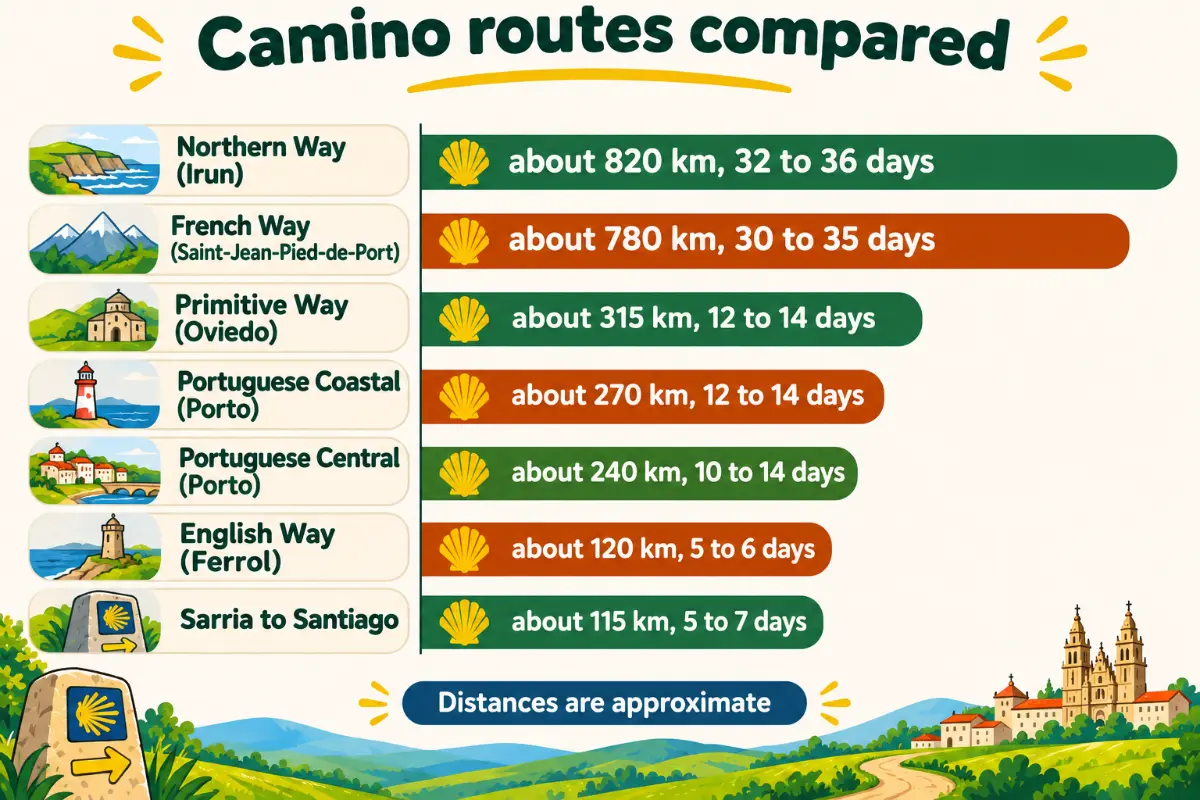
The table compares the seven main routes by length, walking time, difficulty and crowds. Distances are approximate and vary by a few kilometers between guidebooks.
| Route | Full start | Full distance | Days | Difficulty | Crowds |
|---|---|---|---|---|---|
| French Way (Camino Francés) | Saint-Jean-Pied-de-Port, France | about 770 to 800 km | 30 to 35 | Moderate, hard over the Pyrenees | Very busy |
| Portuguese Way, Central | Porto (or Lisbon) | about 240 km (about 620 km from Lisbon) | 10 to 14 | Easy to moderate | Busy |
| Portuguese Way, Coastal | Porto | about 260 to 280 km | 12 to 14 | Easy to moderate | Busy and growing |
| Northern Way (Camino del Norte) | Irún | about 800 to 825 km | 32 to 36 | Challenging, many climbs | Moderate |
| Primitive Way (Camino Primitivo) | Oviedo | about 310 to 320 km | 12 to 14 | Challenging, mountains | Quiet |
| English Way (Camino Inglés) | Ferrol | about 120 km | 5 to 6 | Moderate | Quiet |
| Vía de la Plata | Seville | about 1,000 km | 40 to 50 | Challenging, long stages and heat | Very quiet |
The UNESCO World Heritage listing for these routes is called the Routes of Santiago de Compostela.
Which Camino routes are the most popular?
The French Way is by far the most walked route: in 2025 it brought nearly half of all pilgrims to Santiago. The Portuguese Way is second, and its Coastal variant is the fastest growing route of recent years.
Pilgrim’s Reception Office figures for 2025 count roughly 531,000 pilgrims. About 242,000 of them arrived on the French Way, about 101,000 on the Portuguese Central route and about 90,000 on the Portuguese Coastal route. American Pilgrims on the Camino reports that the Coastal route grew 20% and the Primitive Way 14% in 2025, while the French Way grew 2%.
Popularity has two sides. Busy routes mean more beds, cafés and company; quiet routes mean fewer services and more planning.
Good to know. UNESCO protects the French Way and four northern routes, including the Primitive Way and the coastal Northern Way, as one World Heritage Site.
French Way (Camino Francés): the classic
The French Way is the best choice if you want the full, traditional Camino experience and have about five weeks. It runs across northern Spain from Saint-Jean-Pied-de-Port in France over the Pyrenees to Pamplona, Burgos and León, then into the green hills of Galicia.
- Best for: first-timers with time, social walkers, history and architecture lovers.
- Highlights: the Pyrenees crossing, Pamplona, Burgos and León cathedrals, the open plateau of the meseta, O Cebreiro.
- Downsides: crowds on the last 100 km, a long flat middle section some walkers find monotonous.
- Shorter options: start in León (about 310 km), Ponferrada (about 200 km) or Sarria (just over 100 km).
Sarria is the most common start of any route: 31% of all pilgrims began there in 2025, according to American Pilgrims on the Camino.
Portuguese Way (Camino Portugués): gentle and varied
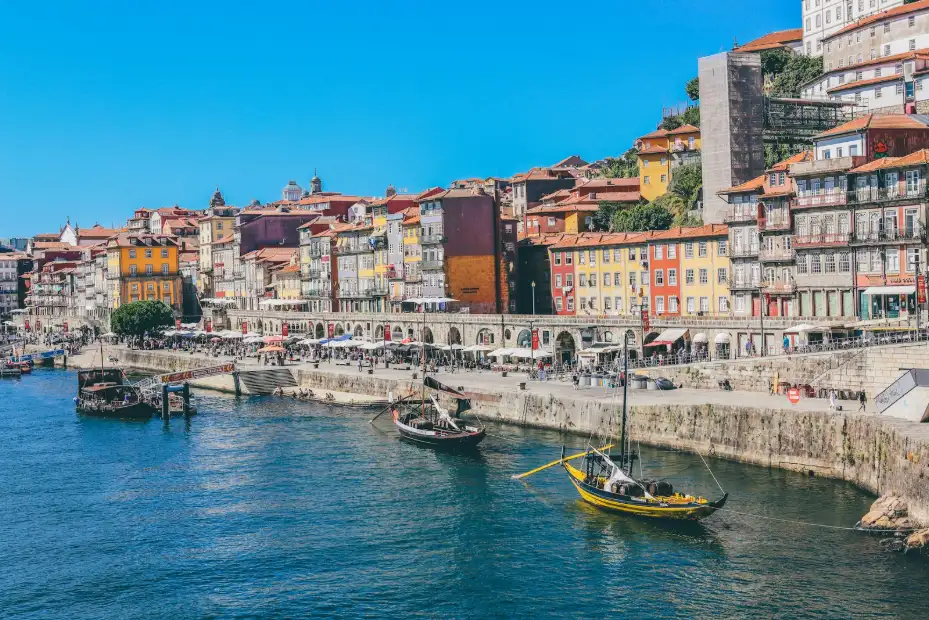
The Portuguese Way is the easiest route for a two-week Camino. From Porto, the Central route goes inland through vineyards and old towns such as Ponte de Lima and Tui, and the Coastal route follows the Atlantic before turning inland near Redondela.
- Best for: beginners with 10 to 14 days, walkers who prefer flat terrain, food lovers.
- Central or Coastal? Central is greener, has more albergues and follows the historic route. Coastal has sea views, boardwalks and beaches but more road walking near towns.
- Short option: start in Tui on the Portuguese border (about 119 km) or in Vigo on the coast (about 100 km).
- Long option: start in Lisbon for about 620 km and four weeks.
The Central route has more pilgrim services, so it is the safer pick for a first Camino; choose the Coastal route if sea views matter more to you than albergue choice.
Northern Way (Camino del Norte): coast and climbs
The Northern Way is the most scenic coastal route but also one of the hardest. It follows the Bay of Biscay for about 800 km from Irún on the French border through San Sebastián, Bilbao, Cantabria and Asturias, then turns inland and joins the French Way at Arzúa.
- Best for: fit walkers, beach and sea lovers, people who want fewer crowds over five weeks.
- Highlights: San Sebastián, the Basque coast, Cantabrian beaches, Asturian fishing villages.
- Downsides: constant ups and downs, fewer albergues, more planning in early spring and autumn.
Primitive Way (Camino Primitivo): the original route
The Primitive Way is often called the first Camino, and it is the toughest of the popular routes. It starts in Oviedo and crosses the mountains of Asturias and Galicia for about 315 km, joining the French Way at Melide for the last two days.
- Best for: experienced hikers with two weeks who want wild landscapes and quiet trails.
- Highlights: the Hospitales mountain stage, the Roman walls of Lugo, remote villages.
- Short option: start in Lugo, about 100 km from Santiago.
- Downsides: steep climbs and descents, limited beds in small villages.
English Way (Camino Inglés): short and quiet
The English Way is the best short alternative to Sarria if you want fewer people. Pilgrims from Britain and northern Europe once sailed to Ferrol or A Coruña and walked from there; today the route from Ferrol is about 120 km and takes 5 or 6 days.
Start in Ferrol if you want the Compostela. The branch from A Coruña is only about 75 km, which is below the 100 km minimum, so the Pilgrim’s Reception Office does not accept it on its own.
Vía de la Plata: the long southern route
The Vía de la Plata is the longest of the main routes, about 1,000 km from Seville north through Extremadura and Castilla y León. It follows an old Roman road, sees very few pilgrims and suits experienced long-distance walkers.
Stages are long, villages are far apart and summers in the south are very hot, so most people walk it in spring or autumn. A shorter taste is to start in Ourense, about 116 km from Santiago.
Which Camino route is the most beautiful?
There is no official answer, but three routes come up most often when pilgrims talk about scenery: the Northern Way for its coastline, the Primitive Way for its mountains and the Portuguese Coastal route for its beaches and Atlantic views.
The French Way offers the most variety in one walk, from the Pyrenees and the vineyards of La Rioja to the wide plateau of the meseta and the green hills of Galicia. If landscape matters most to you, choose by the kind of scenery you love rather than by a ranking.
Where to start each route to walk the last 100 km
Every main route has a town just over 100 km from Santiago, which is the minimum walking distance for the Compostela. The Pilgrim’s Reception Office requires at least 100 continuous km on foot, or 200 km by bike, on the same route, ending at the cathedral.
| Route | Start town | Distance to Santiago | Walking days |
|---|---|---|---|
| French Way | Sarria | about 111 to 117 km | 5 to 7 |
| Portuguese Way, Central | Tui | about 119 km | 6 to 7 |
| Portuguese Way, Coastal | Vigo | about 100 km | 5 to 7 |
| Primitive Way | Lugo | about 100 km | 5 to 7 |
| English Way | Ferrol | about 120 km | 5 to 6 |
| Vía de la Plata | Ourense | about 116 km | 6 to 7 |
Start a few kilometers before the 100 km point if you can. Small detours do not count, and arriving with a little extra distance removes any doubt at the Pilgrim’s Reception Office.
Watch the A Coruña branch. The English Way from A Coruña is only about 75 km, below the 100 km minimum. Start in Ferrol if you want the Compostela.
How to choose your Camino route
The simplest way to choose a Camino is to start with the number of days you have, then decide between busy and quiet, and flat and hilly. Use this short guide:
| You have | You want company and easy logistics | You want quiet trails | You want a physical challenge |
|---|---|---|---|
| About 1 week | Sarria to Santiago | English Way from Ferrol | Lugo to Santiago (Primitive) |
| About 2 weeks | Portuguese Way from Porto | Portuguese Coastal in spring or autumn | Primitive Way from Oviedo |
| About 5 weeks | French Way from Saint-Jean | Vía de la Plata (6 weeks or more) | Northern Way from Irún |
Then check two practical points. Fitness: a hilly route with 25 km days is a different trip from a flat one, so take our Camino fitness quiz before you commit. Season: quieter routes have fewer albergues open from November to March, so they are easier to walk from April to October.
Can you combine or extend Camino routes?
Yes, routes meet and branch, so you can combine them. The Northern Way joins the French Way at Arzúa, the Primitive Way joins it at Melide, and some pilgrims switch from the Northern Way to the Primitive Way at Villaviciosa in Asturias.
After Santiago, many pilgrims add the walk to Finisterre or Muxía on the Atlantic coast, about 90 km to Finisterre and about 120 km with both. It is the only route that starts in Santiago instead of ending there.
Common mistakes when choosing a route
Most route regrets come from planning too much distance too early or walking a quiet route in the wrong season. Watch out for these four:
- Planning 30 km days from day one. Most first-timers are happier at 18 to 22 km a day for the first week.
- Picking a quiet route for a first solo Camino in winter. Many albergues on the Northern, Primitive and Vía de la Plata routes close or have few beds off season.
- Starting exactly at 100 km. Leave a margin for the Compostela.
- Ignoring the calendar. 2027 is a Holy Year, and the last 100 km of the French and Portuguese Ways will be busier than usual.
Ready to narrow it down? Take the which Camino route is right for you quiz, or start with our beginner’s guide to the Camino de Santiago if you are new to the whole idea.