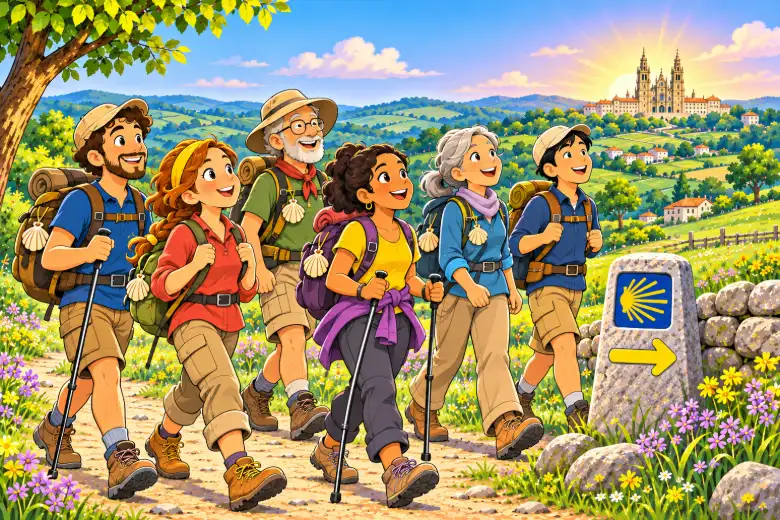
The Camino de Santiago is a network of historic pilgrimage routes across Spain, Portugal and France that all end at the cathedral of Santiago de Compostela in north-west Spain, where tradition places the tomb of Saint James the Apostle. Most people walk it, a few cycle it, and anyone who covers at least the last 100 km on foot can receive the Compostela certificate.
This guide explains what the Camino is, how long it takes, which route suits a first-timer, what it costs and how to plan your first walk. It uses the latest official figures from the Pilgrim’s Reception Office in Santiago and links to our free quizzes so you can check your own readiness as you read.
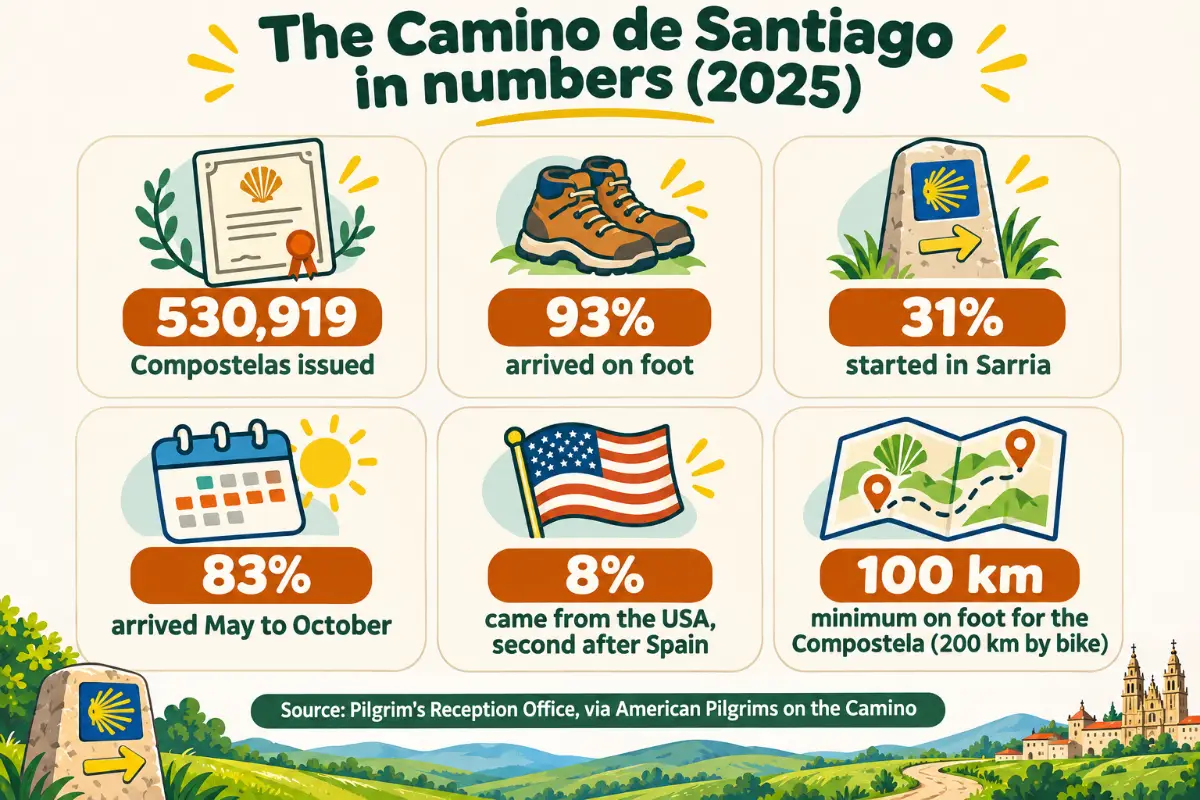
- 530,919 pilgrims received the Compostela in 2025, a record year, and 93% of them arrived on foot.
- Routes range from about 115 km (Sarria to Santiago, 5 to 7 days) to about 780 km (the full French Way, roughly 5 weeks).
- Public albergues in Galicia cost 10 euros a night, and a simple budget is about 25 to 50 euros a day.
- Americans are the second largest group of pilgrims after Spaniards, at 8% of all arrivals in 2025.
What is the Camino de Santiago, in simple terms?
The Camino de Santiago, also called the Way of St James, is a long-distance walk to Santiago de Compostela that people have made since the Middle Ages. “Camino” means “way” or “road” in Spanish, and there is no single trail: dozens of routes start in different towns and countries and meet in the same city.
Along every route you follow yellow arrows and stone markers with a scallop shell, the symbol of the pilgrimage. You sleep in pilgrim hostels called albergues or in small hotels, eat in village bars and walk from one town to the next each day. You also carry a pilgrim passport called the credencial and collect stamps in it to show where you have been.
UNESCO lists the main Spanish routes as a World Heritage Site under the name “Routes of Santiago de Compostela: Camino Francés and Routes of Northern Spain”. The French Way was inscribed in 1993 and four northern routes were added in 2015, according to the UNESCO World Heritage Centre.
Where does the Camino start and end?
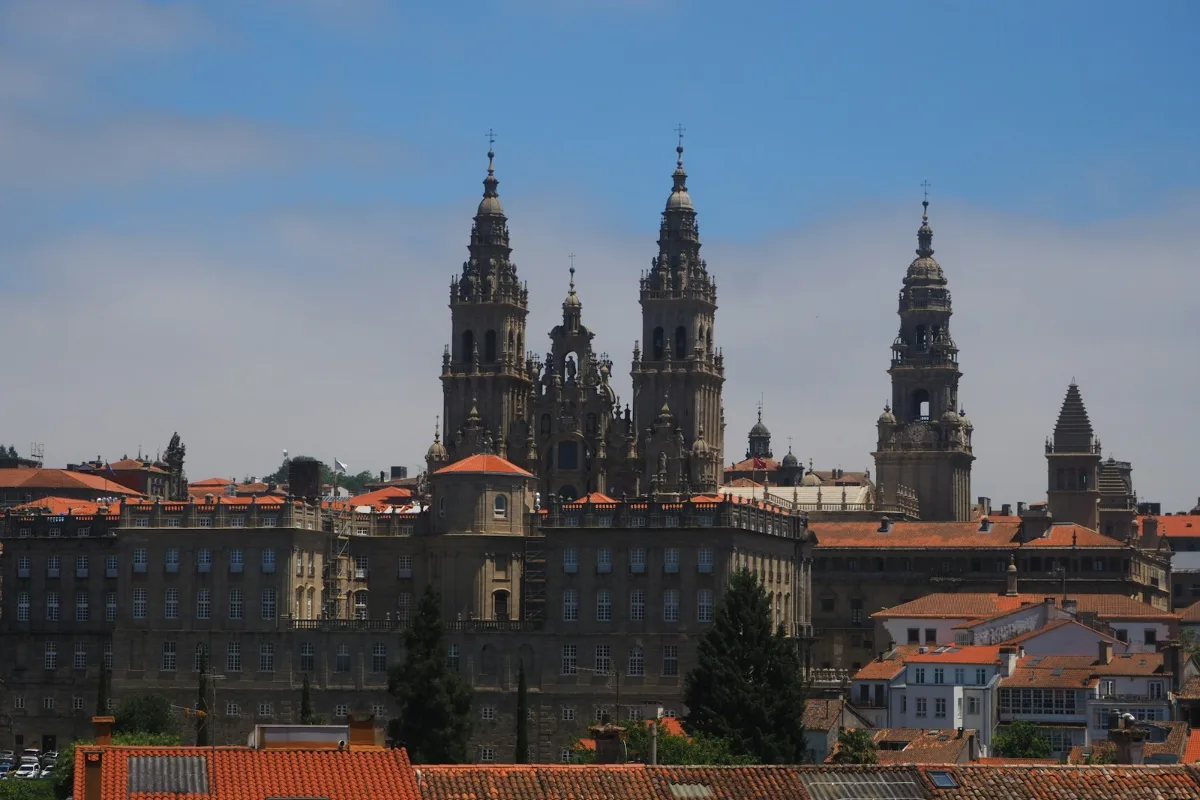
Every Camino ends at the Cathedral of Santiago de Compostela in Galicia, Spain. The start is up to you: you can begin at the traditional starting point of a route, in any town along it, or literally at your front door, as medieval pilgrims did.
The most common starting points are:
- Sarria, Spain: just over 100 km from Santiago on the French Way. In 2025, 31% of all pilgrims started here.
- Saint-Jean-Pied-de-Port, France: the classic start of the full French Way, at the foot of the Pyrenees. US pilgrims are twice as likely as average to start here.
- Porto, Portugal: the usual start of the Portuguese Way, on the Central or the Coastal route.
- Tui, Spain: on the border with Portugal, about 120 km from Santiago.
- Ferrol, Spain: the start of the English Way, about 120 km from Santiago.
Many pilgrims continue after Santiago to Finisterre or Muxía on the Atlantic coast, a walk of about 90 to 120 km that many still call “the end of the world”.
How long does it take to walk the Camino de Santiago?
Walking the Camino takes anywhere from 5 days to more than 5 weeks, depending on the route and the starting point. Most pilgrims walk 20 to 25 km a day, so you can estimate the number of walking days by dividing the distance by about 22 km and adding rest days.
| Route | Usual start | Distance | Walking days | Terrain |
|---|---|---|---|---|
| French Way (Camino Francés) | Saint-Jean-Pied-de-Port | about 770 to 800 km | 30 to 35 | Mixed, hard over the Pyrenees |
| Sarria to Santiago (last part of the French Way) | Sarria | about 111 to 117 km | 5 to 7 | Rolling green hills |
| Portuguese Way, Central | Porto | about 240 km | 10 to 14 | Easy to moderate |
| Portuguese Way, Coastal | Porto | about 260 to 280 km | 12 to 14 | Mostly flat, by the Atlantic |
| Northern Way (Camino del Norte) | Irún | about 800 to 825 km | 32 to 36 | Hilly coast |
| Primitive Way (Camino Primitivo) | Oviedo | about 310 to 320 km | 12 to 14 | Mountains, demanding |
| English Way (Camino Inglés) | Ferrol | about 120 km | 5 to 6 | Moderate |
Distances differ slightly between guidebooks because of detours, town centers and how each source measures. The ranges above come from route tables published in 2026 and from UNESCO, which gives 738 km for the Spanish section of the French Way.
Which Camino route is best for beginners?
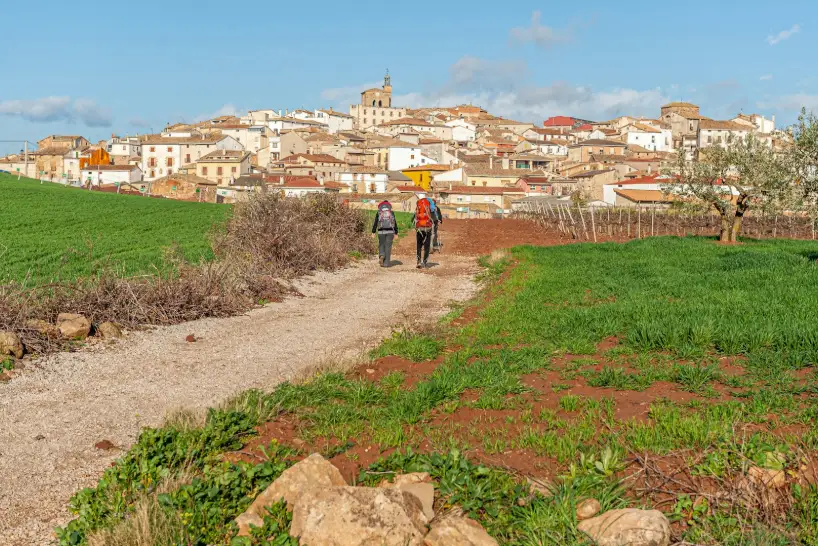
For most first-timers the best choice is either Sarria to Santiago, if you have one week, or the Portuguese Way from Porto, if you have two. Both are well marked, have plenty of beds and cafés, and both cover more than the 100 km needed for the Compostela.
Choose by the time you have and the kind of trip you want:
- One week, first Camino: Sarria to Santiago. Busy and social, with Galician villages, forests and food.
- One week, fewer crowds: the English Way from Ferrol.
- Two weeks, gentle terrain: the Portuguese Way from Porto, Central or Coastal.
- Two weeks, real challenge: the Primitive Way from Oviedo, for fit hikers.
- Five weeks, the classic: the full French Way from Saint-Jean-Pied-de-Port.
If you are still unsure, take our Camino route finder quiz. It asks 9 questions about time, fitness and style and matches you with one of six routes.
Who walks the Camino, and do you have to be religious?
You do not have to be religious to walk the Camino. People walk it for faith, for reflection, for sport, for culture or simply to take time out, and albergues and trails are open to everyone.
The official figures show how broad the crowd is. American Pilgrims on the Camino publishes the data of the Pilgrim’s Reception Office every year. Here is what 2025 looked like:
| Indicator | All pilgrims | US pilgrims |
|---|---|---|
| Compostelas issued | 530,919 (+6% on 2024) | 8% of the total, second after Spain |
| Arrived on foot | 93% | no separate figure |
| Aged 46 or older | 50% | 71% |
| Women | 54% | 61% |
| Arrived between May and October | 83% | no separate figure |
In other words, the typical American pilgrim is a woman over 45, and people in their 60s and 70s are a normal sight on every route. Age matters less than preparation and a sensible daily distance.
The religious side is only formal at the end. The Compostela itself is issued to those who walk “for Christian purposes”, in the wording of the Pilgrim’s Reception Office. Pilgrims who walk for other reasons can ask for the Certificate of Distance instead, which costs 3 euros.
What is the Compostela, and how do you earn it?
The Compostela is the free certificate the Pilgrim’s Reception Office in Santiago gives to pilgrims who complete at least 100 km on foot or horseback, or 200 km by bicycle, ending at the cathedral. The distance must be continuous and on the same route, according to the Pilgrim’s Reception Office.
To prove your walk, you carry a credencial (pilgrim passport) and collect stamps (sellos) from albergues, churches, cafés and town halls. The office asks for stamps along the whole route and, over the minimum distance, at the start and end of each stage with the date. In practice that means at least two stamps a day over the last 100 km.
- Get a credencial before you start, from a parish, a pilgrim association, an albergue or the official “Credencial del Peregrino” app. It usually costs about 2 euros.
- Stamp it every day, twice a day over the last 100 km (or the last 200 km by bike).
- In Santiago, take a QR ticket at the Pilgrim’s Reception Office on Rúa Carretas and collect your Compostela. The office is open every day from 10:00 to 19:00, except 25 December and 1 January.
Check the rules at the source. Websites sometimes report “new rules” for the Compostela. The official pages of the Pilgrim’s Reception Office are the only reliable reference.
For example, in 2026 several websites reported “new rules” that would accept any 100 km on any route or require two stamps a day for the whole walk. As of November 2026 the official Compostela and credencial pages still describe the last 100 continuous km on the same route. If you read about a rule change, check the office’s own pages before you rely on it.
Where do pilgrims sleep on the Camino?
Pilgrims sleep mainly in albergues, which are hostels with shared bunk rooms reserved for people walking or cycling the Camino with a credencial. Private rooms in pensiones, guesthouses and hotels are available in most towns too.
| Type | Price per night | Can you book? |
|---|---|---|
| Public albergue in Galicia (Xunta network) | 10 euros | No, first come, first served, one night only |
| Municipal or parish albergue elsewhere | 7 to 14 euros, some by donation | Usually no |
| Private albergue | 14 to 25 euros | Mostly yes |
| Hostal or pensión (private room) | 35 to 70 euros | Yes |
| Hotel or rural house | 55 to 180 euros | Yes |
Prices are 2026 ranges published by American Pilgrims on the Camino and Camino guides. Public albergues of the Xunta de Galicia open at 13:00, close at 22:00 and ask you to leave by 08:00; the regional government lists them on its official Camino portal. Dorms are usually mixed, blankets are not guaranteed and many places take cash only.
Pilgrim tip. Carry 50 to 100 euros in cash. Many albergues and village bars do not take cards.
Not sure you will enjoy a room with 30 strangers? Our pilgrim personality quiz asks exactly that and suggests how to plan around your answer.
How much does the Camino de Santiago cost?
Once you are in Spain, the Camino costs about 25 to 50 euros a day for most independent walkers, plus flights and gear. The daily total depends mostly on where you sleep and whether you eat out.
- Tight budget, about 25 euros a day: public albergues, supermarket food, cooking in albergue kitchens.
- Comfortable budget, about 35 to 50 euros a day: private albergues, breakfast at a bar, a pilgrim menu in the evening.
- Private rooms, 50 euros a day and more: pensiones or hotels and most meals in restaurants.
A pilgrim menu (menú del peregrino), with two courses, dessert, bread and wine or water, usually costs 10 to 18 euros. Optional extras include luggage transfer, about 6 to 8 euros per bag per stage, and laundry, about 4 euros to wash and 5 to dry. A guided package with booked hotels costs much more, often 100 euros a day or more.
When is the best time to walk the Camino?
The best months for most first-timers are May, June, September and early October, when the weather is mild and all albergues are open. July and August are hot inland and the busiest months on the last 100 km, while November to March is quiet, wet and many small albergues close.
Crowds follow the calendar: 83% of pilgrims arrived in Santiago between May and October in 2025, and September was the single busiest month. If you want fewer people, walk in April or late October, start on a weekday or pick a quieter route such as the English or Northern Way.
2027 is a Holy Year, because 25 July, the feast of Saint James, falls on a Sunday. Holy Years bring more pilgrims than usual, so if you plan to walk in 2027, book flights and your first nights early. The next Holy Year after that is 2032.
How fit do you need to be?
You do not need to be an athlete, but you need to be able to walk about 20 km and then do it again the next day with a pack. That repetition, not a single long day, is what tires most beginners and causes blisters and sore knees.
A few months of regular walking, with one long walk a week and some back-to-back days in your Camino shoes, prepares most healthy adults. If you have a health condition, check with your doctor before you start training. To see where you stand today, take our Camino fitness quiz, which gives a readiness score and a personal training list.
What should you pack for the Camino?
Pack light: a common guideline is to carry no more than about 10% of your body weight, including water and food. For someone who weighs 70 kg (154 lb), that is about 7 kg (15 lb).
The core kit is short:
- a 30 to 40 liter backpack
- broken-in trail shoes or boots, plus light sandals for the evening
- two sets of walking clothes and one warm layer
- a rain jacket or poncho and a sun hat
- a light sleeping bag or liner
- a small first-aid kit with blister plasters
- your passport, credencial, phone and an EU plug adapter
Use our backpack weight quiz to build your pack item by item and see if you beat the 10% rule.
Is the Camino de Santiago safe?
The Camino is generally considered a safe walk, with well-marked paths, many other pilgrims and villages every few kilometers on the main routes. The usual risks are practical: blisters, heat, traffic on road sections and the occasional theft in busy albergues.
Keep your passport and money on you, walk with others on isolated stretches if that makes you more comfortable, carry water in summer and save 112, the European emergency number, in your phone. As for the question many beginners are too shy to ask: there are toilets in cafés and bars along most routes, and buying a coffee is the usual way to use them.
How to plan your first Camino in 7 steps
Planning a first Camino comes down to time, route and preparation, in that order. Work through these steps from top to bottom:
- Decide how many days you can walk, including travel to the start.
- Choose a route and a starting point that fit those days.
- Pick your season and book flights; in 2027 book earlier than usual.
- Start training two to three months ahead in the shoes you will wear.
- Buy or check your gear and weigh your packed backpack.
- Get your credencial and decide whether to book beds or go albergue to albergue.
- Download an offline map, save 112 and walk your first stage slowly.
All five of our free tools, from the route finder to the first-aid kit quiz, are on our Camino quizzes page.
Questions first-timers often ask
Can you walk the Camino alone?
Yes. Many pilgrims start alone, and on the main routes you meet the same people again and again in cafés and albergues, so you are rarely on your own unless you want to be.
Can you walk the Camino with children?
Yes, and in 2025 more than 8% of pilgrims were under 18, according to Pilgrim’s Reception Office data. Shorter routes such as Sarria to Santiago and shorter daily stages work best with kids.
Do you need to speak Spanish?
No. On the busiest routes many hosts speak some English, and a few words of Spanish, such as “hola”, “gracias” and “buen camino”, go a long way.