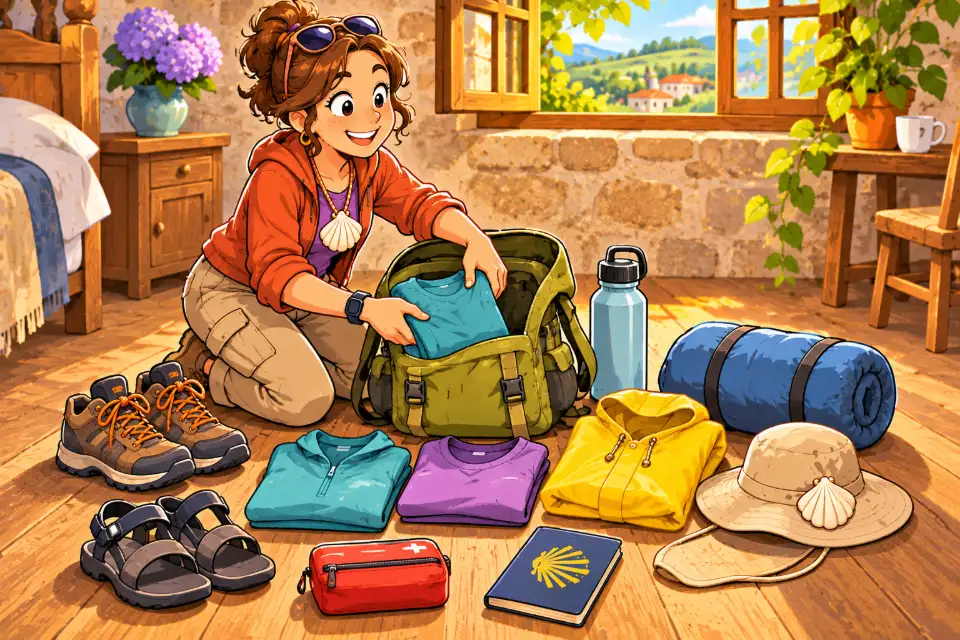
A good Camino de Santiago packing list is short: a 30 to 40 liter backpack, two pairs of footwear, two sets of quick-dry clothes, one warm layer, rain protection, a light sleeping bag or liner and a small foot-care kit. Packed with water and snacks, it should weigh no more than about 10% of your body weight.
Below is the full checklist we recommend for a spring, summer or autumn Camino, with typical weights, what to leave at home and how to adjust for the season. It is built for albergue walkers who carry their own pack.
How heavy should your Camino backpack be?
Aim for a total pack weight of about 10% of your body weight, including water. American Pilgrims on the Camino gives the same guideline and stresses that it is a rule of thumb, not a hard limit.
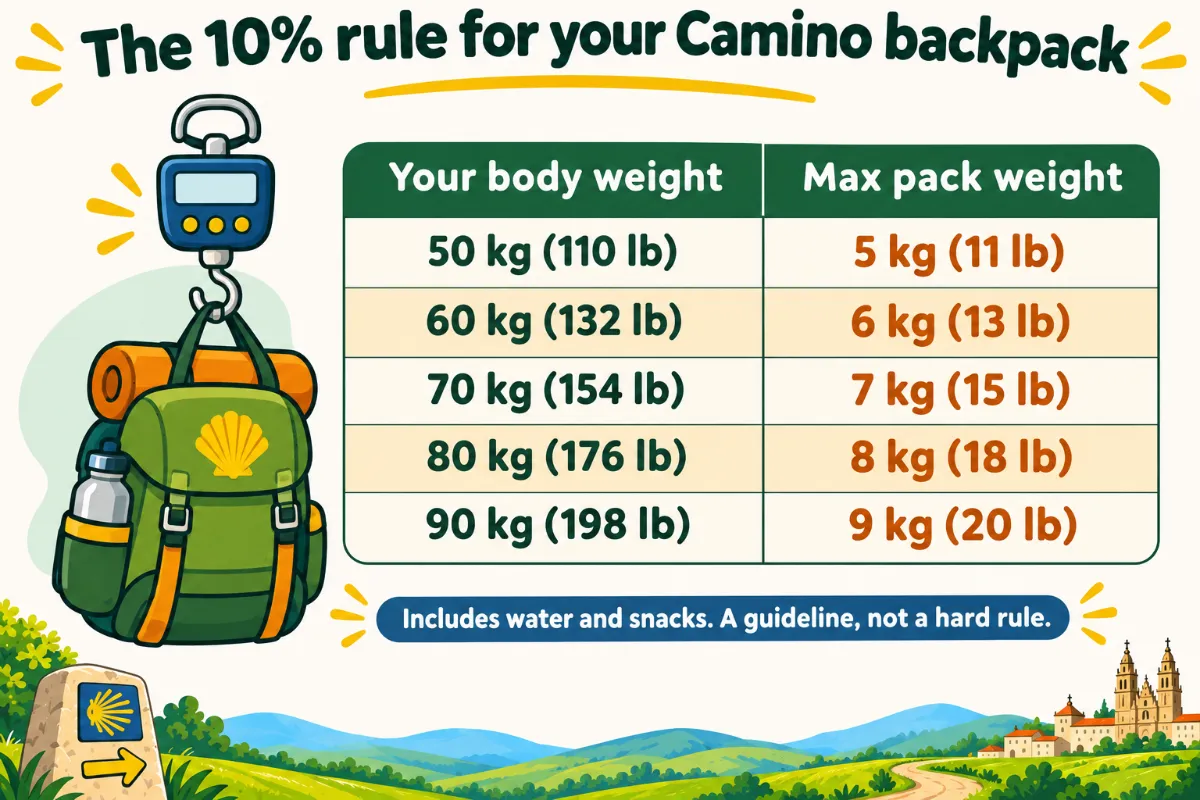
| Your body weight | Target pack weight |
|---|---|
| 50 kg (110 lb) | 5 kg (11 lb) |
| 60 kg (132 lb) | 6 kg (13 lb) |
| 70 kg (154 lb) | 7 kg (15 lb) |
| 80 kg (176 lb) | 8 kg (18 lb) |
| 90 kg (198 lb) | 9 kg (20 lb) |
Lighter people often struggle to reach 10% and land at 6 or 7 kg; that is normal. What matters is that every item earns its place, because you will carry it 20 km or more every day. Try our backpack weight quiz to see how your own choices add up.
The complete Camino packing checklist
Our Camino checklist covers everything most pilgrims need between April and October. Typical weights are for lightweight versions of each item; weigh your own gear at home for the real total.
| Item | Quantity | Typical weight |
|---|---|---|
| Backpack, 30 to 40 liters, with hip belt | 1 | 0.9 to 1.4 kg |
| Light sleeping bag or sleeping bag liner | 1 | 0.2 to 0.8 kg |
| Quick-dry T-shirts | 2 | 0.3 kg |
| Light long-sleeve top | 1 | 0.2 kg |
| Warm layer (fleece or light puffer) | 1 | 0.3 kg |
| Hiking pants and shorts (or convertible pants) | 1 each | 0.5 kg |
| Hiking socks | 2 to 3 pairs | 0.2 kg |
| Underwear | 2 to 3 | 0.15 kg |
| Rain jacket or poncho | 1 | 0.3 kg |
| Sun hat or cap | 1 | 0.1 kg |
| Sport sandals for the evening | 1 pair | 0.3 kg |
| Quick-dry towel | 1 | 0.15 kg |
| Travel-size toiletries | 1 bag | 0.4 kg |
| First-aid and foot-care kit | 1 | 0.2 kg |
| Phone, charger, EU plug adapter | 1 set | 0.3 kg |
| Water bottle (1 liter, full) | 1 | 1.0 kg |
The checklist adds up to about 5.5 to 6.5 kg including a full liter of water, before snacks. Your walking shoes and the clothes you wear do not count toward the total.
Footwear: the most important choice
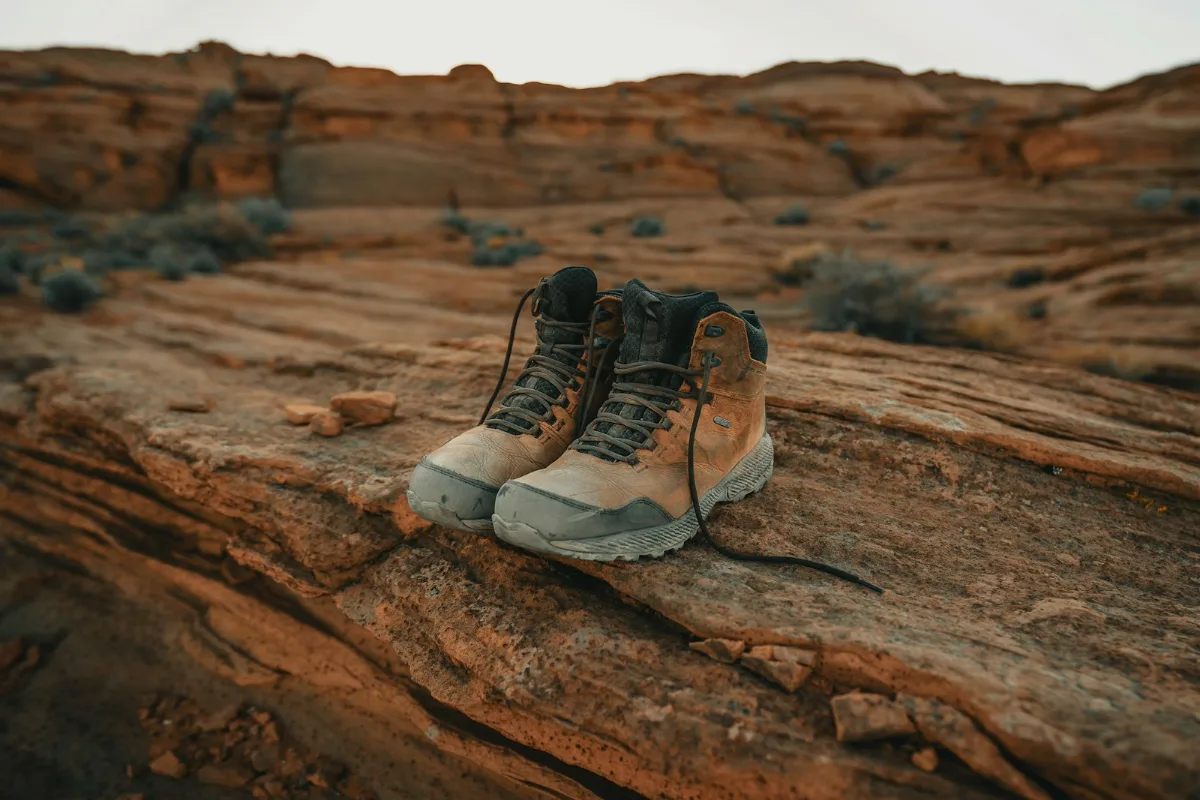
Your shoes matter more than any other item, and the best pair is the one you have already walked in for weeks. Most pilgrims bring two pairs: trail runners, hiking shoes or light boots for walking, plus sport sandals for the evening and for rest days.
- Trail runners or boots? Trail runners are lighter and dry faster, which is why many pilgrims choose them from May to October. Light boots give more ankle support on rocky routes such as the Primitive Way.
- Size: many walkers buy half a size to a full size larger, because feet swell over long days.
- Waterproof or not? Waterproof shoes keep out puddles but hold heat and sweat. In warm months breathable shoes usually work better.
- Test them: walk at least a few 15 to 20 km days in your shoes before you fly.
Pilgrim tip. Buy your shoes at least two months before the trip, so you have time to swap them if they rub.
Socks and foot care: how to avoid blisters
Blisters come from moisture and friction, so the right socks and a small foot-care kit prevent most of them. Choose merino wool or synthetic hiking socks instead of cotton. On hot days, change into a dry pair at lunch.
Your foot-care and first-aid kit should fit in a small zip bag:
- blister plasters (hydrocolloid) and strong tape
- a small pair of scissors
- antiseptic wipes
- pain relief you already use at home
- sunscreen and lip balm
- your prescription medicines, with a copy of the prescription
You can buy all of this in Spanish pharmacies along the main routes, so there is no need to carry a large kit. Test your knowledge with our Camino first-aid kit quiz, 10 quick true or false questions with explanations.
Clothes: the two-set system
Pack two sets of walking clothes: wear one, and wash the other by hand in the afternoon so it dries overnight. Every albergue has a sink for laundry, and many have washing machines.
Choose synthetic or merino fabrics that dry fast and do not smell after one day. Add one warm layer for cool mornings and evenings, and something clean and comfortable to wear in town. That is all: a third full set of clothes is the most common thing pilgrims send home from the first post office.
Good to know. Every albergue has a sink for hand washing, and many have washing machines and dryers for a few euros.
Sleeping gear for albergues
Bring a light sleeping bag or a sleeping bag liner, because albergues do not always provide blankets. Public albergues usually give you a disposable sheet and pillowcase, and many private albergues have blankets, but you cannot count on it everywhere.
- June to September: a silk or cotton liner, or a summer sleeping bag rated around 15 °C (59 °F).
- Spring and autumn: a light sleeping bag around 5 to 10 °C (41 to 50 °F).
- Also useful: earplugs and an eye mask, since dorms are shared and lights go on early.
Read more about dorms, prices and booking in our guide to where to sleep on the Camino.
Documents, money and electronics
The essentials are your passport, your pilgrim passport (credencial), a bank card, some cash and your phone. Many small albergues and village bars accept cash only, so keep 50 to 100 euros on you and use ATMs in larger towns.
- passport or national ID card, plus travel insurance details
- credencial (pilgrim passport), kept in a zip bag
- bank card and some euros in cash
- phone with offline maps and a Camino app
- charger and an EU plug adapter (type C, the two round pins)
- a small power bank if you use your phone a lot
Leave the laptop and tablet at home. Your phone covers maps, photos, bookings and reading.
Optional items many pilgrims are glad they took
Optional extras like the ones below are not essential, but they are light and come up again and again in pilgrims’ lists:
- Trekking poles: helpful on long descents. Pack them in checked luggage, as American Pilgrims on the Camino advises.
- Clothes pins or safety pins: to dry laundry on your pack while you walk.
- Buff or bandana: sun, sweat and cold in one item.
- Headlamp: for early starts and for finding your bunk without waking others.
- Zip bags or packing cubes: to keep things dry and organized.
- A small notebook: many pilgrims keep a journal.
What not to pack
Leave at home anything you are packing “just in case”. Spain has shops, pharmacies and laundries in every town of any size on the main routes.
The usual suspects are a third or fourth set of clothes, a warm winter sleeping bag outside winter, full-size toiletries, a laptop or tablet, heavy paper books, a spare pair of boots and jeans or cotton hoodies that never dry.
If your pack is still too heavy after you start, you can send a box ahead by post. Spain’s postal service runs a parcel service for pilgrims, and luggage transfer companies move bags between stages for about 6 to 8 euros a day.
How to adjust your packing list by season
The core list stays the same all year; you only swap a few items. Summer is about sun and heat, winter about rain, cold and short days.
| Season | Add | Leave out |
|---|---|---|
| Summer (June to August) | sun hat with brim, extra sunscreen, electrolyte tablets, a second water bottle on the meseta | warm sleeping bag, heavy fleece |
| Spring and autumn | warmer layer, light gloves, a rain jacket instead of a poncho on windy routes | second water bottle |
| Winter (November to March) | warm sleeping bag, thermal base layer, waterproof shoes, headlamp | sandals if you will not use them |
Packing tips from the trail
Pack your bag once at home, then walk 15 km with it before you fly. That single test shows what rubs, what is too heavy and what you never touched.
- Put heavy items close to your back and in the middle of the pack.
- Line your backpack with a large plastic bag or a dry bag; rain covers alone often leak.
- Keep your credencial, passport and phone in one small pouch you never leave behind.
- Check the weather the week before and adjust your layers.
New to the whole idea? Start with our beginner’s guide to the Camino de Santiago, then check your fitness with the Camino fitness quiz.